Winners and Losers of Maine Business in 2026 So Far: Defense Booms, Paper Sweats
Defense, diagnostics and banking are booming in Maine while paper, manufacturing and industrial real estate shed jobs and tenants.
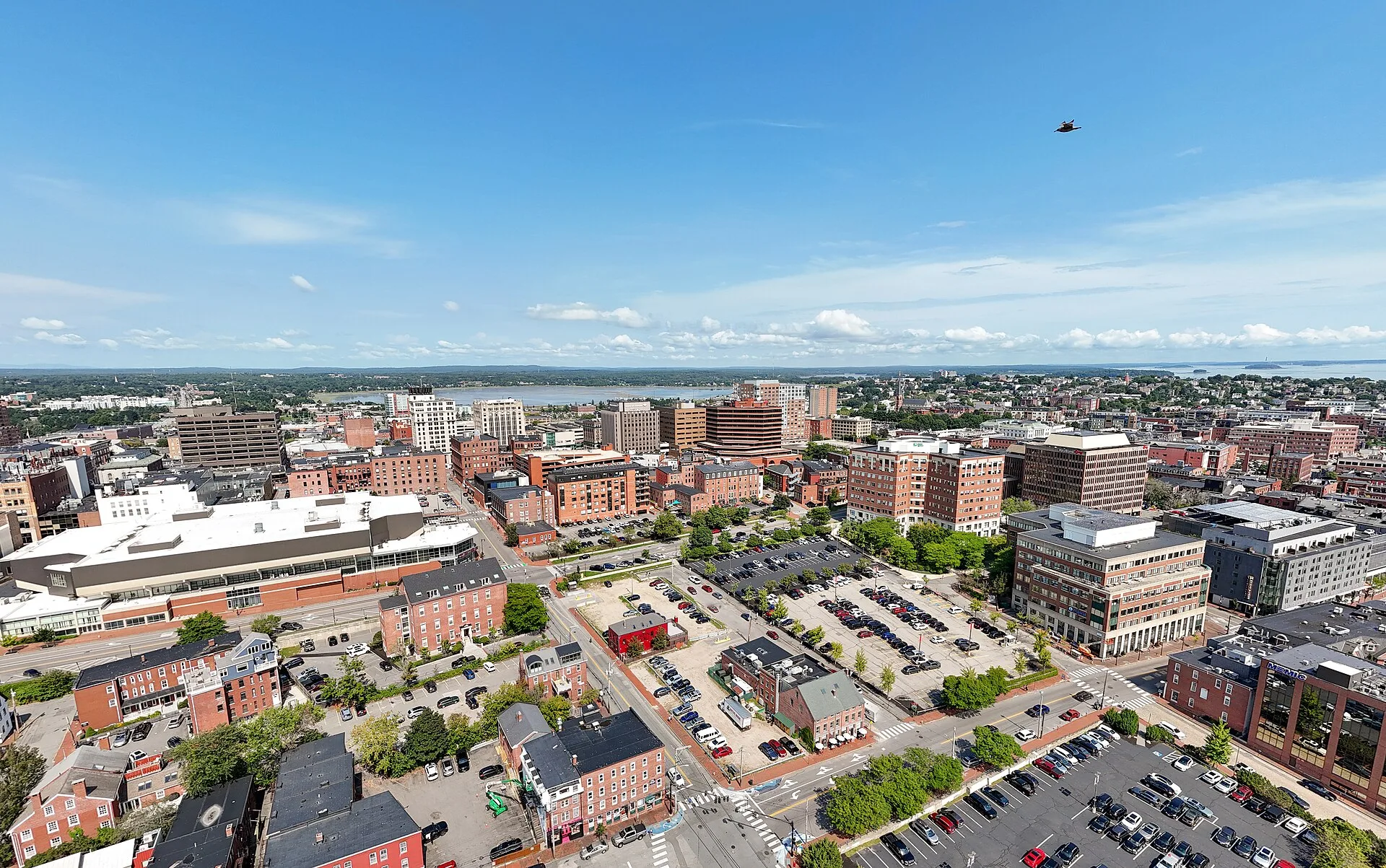
File photo: Aerial view of Portland, Maine. Photo: Quintin Soloviev / CC BY 4.0 via Wikimedia Commons
Maine had two economies between January and September 2026, and only one of them is having a good year.
In one Maine, precision manufacturers are running defense-driven backlogs, the Kittery shipyard is getting a nine-figure federal upgrade, and diagnostics and banking companies are posting some of the best numbers in their history. In the other Maine, paper mills are fighting for survival, a toy factory and a bottle-redemption processor are cutting jobs, and industrial landlords from York County to Lewiston-Auburn are sitting on the emptiest buildings in more than a decade. We think that if 2026's headline economic numbers come in strong, they will tell policymakers a flattering story that isn't true for the whole state — and that mistaking one Maine for the other risks leaving the losing half of the economy to fend for itself.
Start with the winners. IDEXX's second-quarter earnings jumped 18 percent, beating Wall Street's expectations, Mainebiz reported. Lewiston's Elmet Group, a precision manufacturer, closed an upsized IPO in April 2026, GlobeNewswire reported, and is now running a record backlog on defense demand, Mainebiz reported. The Kittery shipyard — already a hub of Navy submarine work — is set to receive $654 million in infrastructure upgrades, Mainebiz reported. Bangor Savings Bank's parent company doubled its net income for the fiscal year, Mainebiz reported, on top of $711 million in home loans the bank issued in 2025, the Bangor Daily News reported. And Tambrands is putting $40 million into expanding its Auburn plant, the only North American factory making tampons and related products, the Sun Journal reported.
That is a genuinely good run for defense suppliers, diagnostics, banking and a handful of manufacturers with pricing power. It is not, in our view, a good year for Maine business as a whole.
Set those numbers against what is happening in legacy manufacturing and industrial real estate. A Waldo County maker of Lincoln Logs will close its plant and cut 115 jobs, Mainebiz reported. CLYNK plans to close its Biddeford processing facility, cutting 54 jobs, Mainebiz reported. A Baileyville paper mill is facing a $794,000 fine for willful safety violations, Mainebiz reported — in our view, the kind of citation that shows up at a mill running lean, not one investing for the future. Rumford's ND Paper mill, one of Maine's remaining paper mills, is racing to survive amid industry changes, Central Maine reported. And industrial vacancies from York County to the Lewiston-Auburn area reached a 13-year high, Mainebiz reported, a sign that the space closures leave behind isn't filling back up.
Layer trade policy on top and the split gets sharper. Rising U.S.-Canada trade tensions are raising red flags for Maine businesses, Mainebiz reported, and Sen. Susan Collins has personally asked the White House to weigh the trade war's negative impact on the state, The Hill reported — in our view, not a fight she would pick if paper and manufacturing exporters weren't already hurting. That fight has since become a live campaign issue, with Collins and Senate challenger Troy Jackson sparring over tariffs, WMTW reported. We think that's the tell: when a sitting senator is lobbying her own party's White House on an industry's behalf, that industry is not sharing in the state's good headlines.
The strongest case against our read is that a boom in defense, diagnostics and banking is exactly the kind of boom that eventually lifts everyone. Elmet's record backlog and the shipyard's $654 million in upgrades mean contractor work, supplier orders and payroll spent at Maine businesses well beyond Kittery and Lewiston; Bangor Savings' record profits fund the lending that Main Street businesses borrow against. We don't dismiss that case — money genuinely does move downstream. But it moves slowly and unevenly, and it does not retrain a paper mill worker in Rumford or a bottle-redemption employee in Biddeford into a precision-machining job on the timeline those workers actually need. The losses we cite above are concentrated in the same sector, month after month; the wins are concentrated in a different sector entirely. A rising tide that skips your dock is not much comfort while you're bailing water.
None of this means Maine is having a bad year, and we are not alleging wrongdoing by any company or official beyond what these outlets already reported. It means Maine is having two different years at once, and the state's policymakers should craft two different responses: one that keeps feeding a defense-and-diagnostics boom, and one that treats paper, legacy manufacturing and industrial real estate as being in a genuine, trade-exposed crunch — not a rounding error in an otherwise strong economy.
Tell us where we're wrong — email the newsroom.